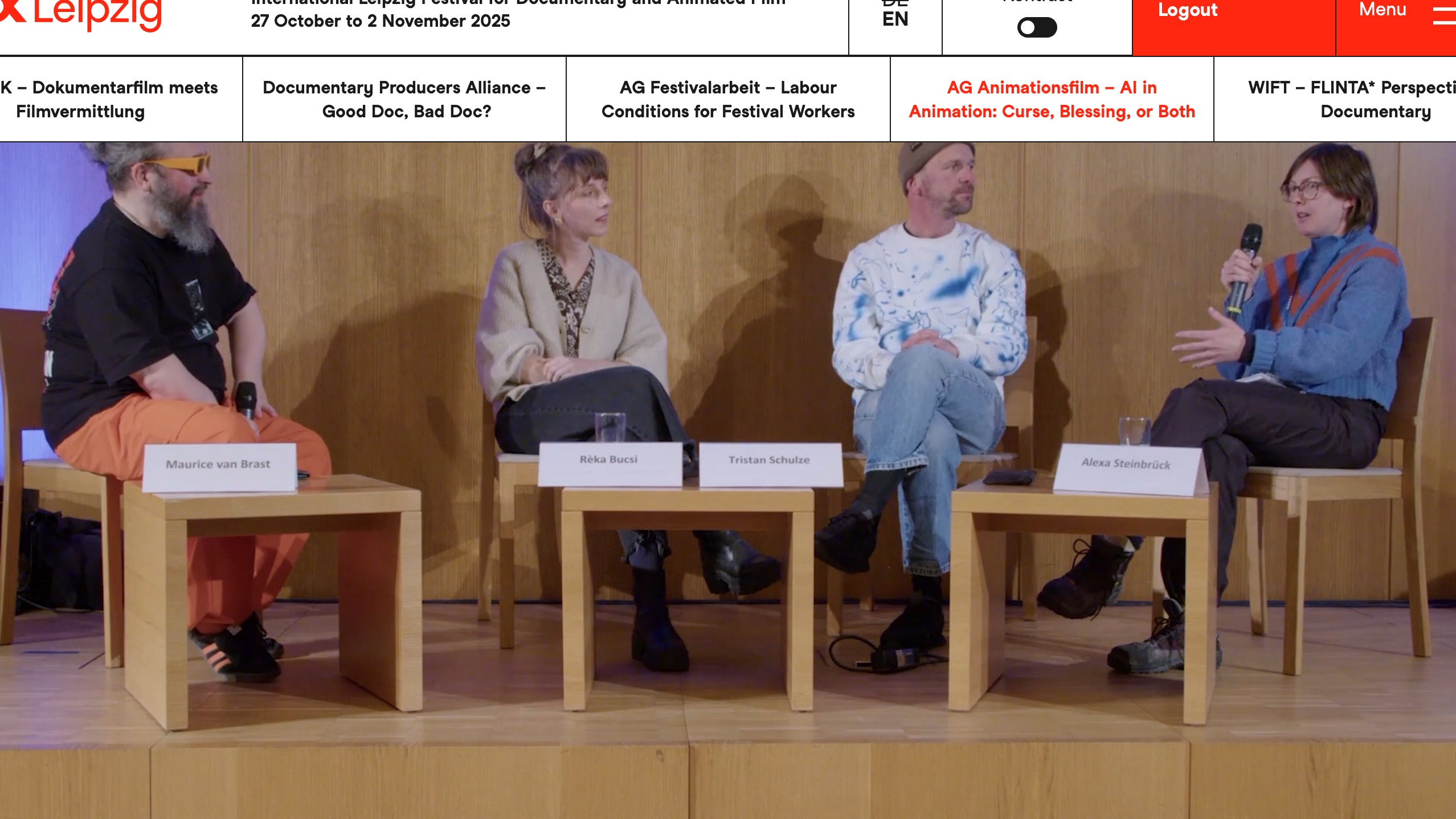
Today I was on stage at a panel about a controversial topic: Artificial intelligence in animation film.
Honestly, I was a bit afraid of the panel: I imagined the room full with angry people RAGING against AI. I had read that there were protests in Annecy (biggest animation festival of the world) against the use of generative AI. At other festivals big parts of the audience left the room when they learned that the film was using AI. I heard that some festivals banned film submissions that used AI.
Instead it was quite calm. (Not sure why)
I’ve been researching the “creative potential” of Artificial Intelligence and Machine Learning for 10+ years. I have been preaching how automated pattern recognition (aka Machine Learning) is exciting for creative usecases. It has been the major topic of my professional life.
But in these times, It’s not the right moment to praise the (few) positive aspects of generative AI technologies. Especially not in front of an audience from the film and animation industry who is already struggling with low wages, budget cuts and huge companies stealing their intellectual property.
I made a lot of critical points in this panel
- there is no “ethical” way of doing genAI (yet)
- the environmental cost of generative video is peak compared to text or image
- “but doing it with AI is cheaper” is an illusion
And it was very interesting to hear from the animation industry professionals what they reported:
In commissioned work animation artists are often not allowed to use ANY generative AI technology (for copyright reasons)
There also was a consensus of frustration with the mainstream genAI tools and their UX:
- You never get what you had in mind! You can’t fully control the output of a genAI model; textual descriptions is not enough to describe something visual;
- It’s a boring and frustrating experience ; I rather do it manually; that’s the only way I can feel real artistic flow;
This discontent of artists with genAI technology is something I have flagged in my talk at Neurips 2022 (https://lnkd.in/djCj8fpC) and further deepened in my paper on creative control and ownership from 2023 (https://lnkd.in/dBf3Q99X).
That being said, I am still a believer that machine learning has a creative potential!
But in order to praise it full-heartedly, we need:
- ethically sourced datasets (opt-out is not enough!)
- a fair compensation model for artists and data donors
- more energy efficient models (especially video)
- rediscovering small datasets and low-resource models
Panellists
Rèka Bucsi (she/her) Animation Filmmaker, Hungary
Alexa Steinbrück (she/her) Software Developer and Artist, Superstruktur Germany
Tristan Schulze (he/him) Professor for Design Practices with Artificial Intelligence, School of Design, Mainz University of Applied Sciences Germany
Links
Event on the DOK website: https://www.dok-leipzig.de/en/partner-events#ag-animationsfilm%C2%A0%E2%80%93-ai-in-animation%3A-curse%2C-blessing%2C-or-both
LinkedIn Post: https://www.linkedin.com/feed/update/urn:li:activity:7389973872567042048/